What Is the Surface Load of SiC Rods?
What is surface load of SiC rods? What’s the standard value? This is a key question when selecting silicon carbide heating elements for stable performance, long service life, and energy efficiency. In the alloy and industrial heating field, understanding surface load helps users match SiC rods to furnace temperature, atmosphere, and operating conditions. This guide explains the concept, standard range, and factors that influence the right surface load choice.
In practical terms, the surface load of SiC rods refers to the wattage carried by each square centimeter of the effective heating surface. It is usually expressed in W/cm2.
There is no single universal standard value that fits every furnace. For most applications, the suitable surface load depends on working temperature, furnace atmosphere, heat loss, installation spacing, and expected service life.
As a general rule, lower surface load supports longer element life and more stable operation, while higher surface load increases heating intensity but also raises the risk of faster aging and uneven performance.
What Is the Surface Load of SiC Rods?
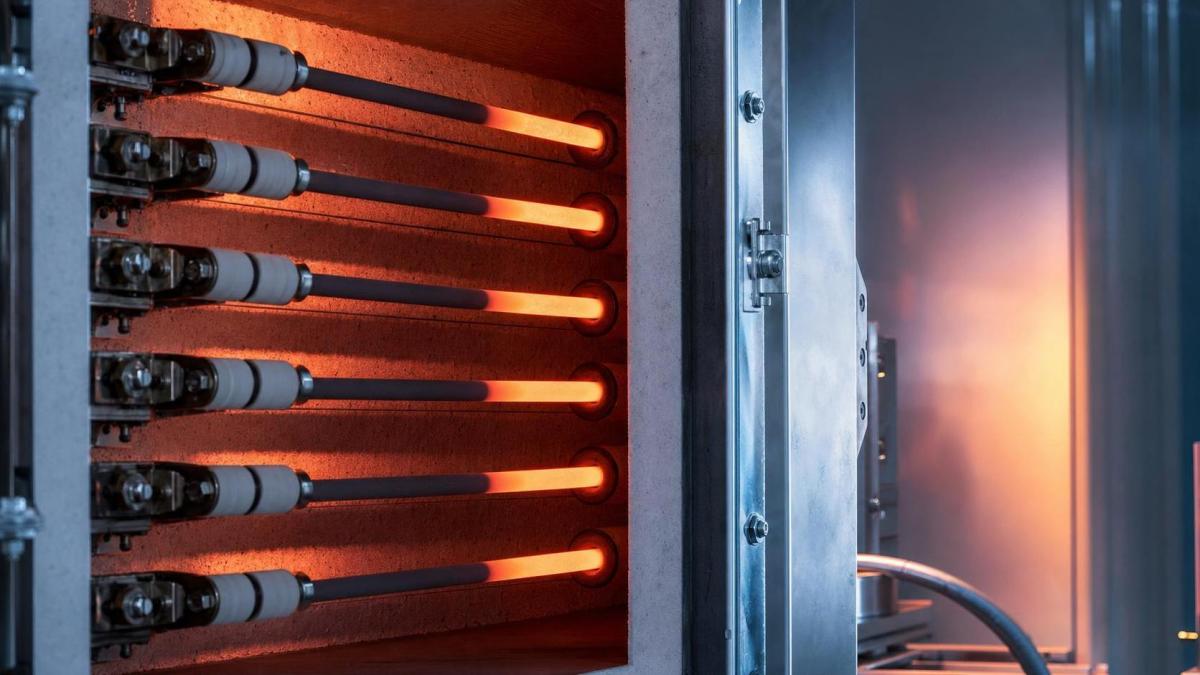
Surface load is the power output divided by the effective hot-zone surface area of the silicon carbide heating element. It is one of the most important parameters in SiC rod selection.
The basic calculation idea is straightforward. First determine the power carried by one rod, then divide that power by the heated surface area that actually radiates heat inside the furnace chamber.
For tubular or rod-type elements, the effective surface area is typically based on the hot-zone diameter and hot-zone length, rather than the total overall length including cold ends.
This matters because two SiC rods may have the same total power, but if one has a smaller effective radiating area, its surface load will be higher and operating stress will also be higher.
In industrial heating, surface load is not just a theoretical number. It directly affects heating rate, element oxidation speed, resistance growth, temperature uniformity, and replacement frequency.
What’s the Standard Value for SiC Rod Surface Load?
When people ask, “What is surface load of SiC rods? What’s the standard value?” they usually want a usable selection range, not an abstract definition.
For many medium and high temperature furnace applications, the common design range is roughly 5 to 8 W/cm2. This is often considered a practical reference zone for stable long-term use.
In lower temperature or life-priority applications, designers may choose around 3 to 5 W/cm2. This lower loading reduces thermal stress and usually helps extend service life.
In some more aggressive designs, especially where faster heating is needed, surface load may rise to 8 to 12 W/cm2. However, this should be evaluated carefully against furnace conditions.
Once the operating temperature becomes very high, especially near the upper working range of silicon carbide elements, the recommended surface load usually needs to be reduced.
That is why suppliers do not normally give only one “standard value.” A better answer is that the correct value is a matched value, based on the actual furnace duty.
Why Surface Load Cannot Be Chosen by One Number Alone
Many buyers expect a fixed standard because it makes procurement easier. In reality, SiC rod performance is strongly linked to the furnace environment and operating pattern.
The first major factor is temperature. As furnace temperature rises, the element’s ability to release heat effectively changes, and the allowable surface load usually decreases.
The second factor is atmosphere. Operation in air is different from operation in protective gas, reducing atmosphere, humidity-rich conditions, or environments with reactive vapors and dust.
The third factor is furnace structure. Heat insulation quality, chamber size, door leakage, ventilation, and workpiece loading all change how much power the elements must deliver.
The fourth factor is control mode. Frequent switching, uneven phase loading, poor voltage stability, or inadequate power matching can push the element beyond the intended design condition.
The fifth factor is production goal. A plant focused on maximum output may accept higher loading, while a plant focused on long maintenance cycles may prefer a more conservative value.
How to Calculate Surface Load in a Practical Way
For users selecting silicon carbide heating elements, the practical method is to calculate required furnace power first, then distribute that power across the planned number of SiC rods.
After that, calculate the effective surface area of one rod’s hot zone. For a cylindrical hot zone, this is approximately the circumference multiplied by the hot-zone length.
The simplified formula is: surface load equals power per rod divided by effective hot-zone area. The result gives a practical basis for checking whether the design is conservative or aggressive.
For example, if one rod carries 1200 watts and the effective hot-zone area is 200 cm2, the surface load is 6 W/cm2, which is within a common industrial reference range.
Even so, this result should still be checked against temperature, atmosphere, and rod arrangement. A mathematically acceptable value may still be unsuitable in a difficult furnace environment.
How Furnace Temperature Affects the Recommended Value
Temperature is often the strongest single variable in SiC rod selection. The higher the furnace chamber temperature, the lower the advisable surface load tends to be.
At moderate temperatures, SiC rods can radiate heat more comfortably while retaining a reasonable operating margin. This makes medium surface load values easier to sustain over time.
At very high temperatures, the element body works under greater thermal stress. Oxidation, resistance increase, and localized overheating become more important concerns.
If surface load is set too high under these conditions, the rod may still heat initially, but service life can shorten significantly and performance can drift more quickly than expected.
That is why experienced manufacturers often recommend derating the design as temperature rises. Lower loading at high temperature usually improves reliability more than it slows production.
How Atmosphere and Process Conditions Change the Right Choice
SiC rods operating in air are the most common case, and most general reference values are based on that condition. But many industrial furnaces do not operate under simple clean-air conditions.
In humid or corrosive atmospheres, the element surface can degrade faster. In reducing atmospheres, the behavior of the protective layer may also change in ways that affect stability.
Processes involving volatile metal compounds, glass vapors, ceramic dust, or chemical emissions can contaminate the element surface and alter heat transfer and aging behavior.
Batch furnaces with frequent door opening may also need more cautious design because repeated thermal cycling increases stress and can make high surface load less desirable.
For these reasons, the same SiC rod size may perform very differently in two furnaces that have the same nominal temperature but very different process conditions.
What Happens If the Surface Load Is Too High or Too Low
If the surface load is too high, the most immediate advantage is faster heating. But this often comes with higher element temperature, quicker aging, and a shorter replacement cycle.
High surface load can also increase the chance of hot spots, uneven furnace temperature, and power imbalance between old and new elements, especially in long-running industrial lines.
On the other hand, if the surface load is too low, the system may be safer for the elements, but furnace heat-up time can become too slow for production requirements.
Overly low loading may also lead to unnecessary equipment cost because more rods, more installation space, and more supporting hardware are required to deliver the same total power.
The best design is rarely the highest or lowest value. It is the value that meets process temperature, cycle time, and maintenance targets with a reasonable operating margin.
How Buyers Can Choose a Suitable Surface Load with More Confidence
For purchasing managers, furnace builders, and technical buyers, the most useful approach is to treat surface load as part of a full application review rather than a catalog-only specification.
Start by confirming the furnace type, target operating temperature, atmosphere, chamber dimensions, product load, heating rate requirement, and expected daily operating hours.
Next, determine whether the priority is quick heat-up, low replacement cost, long element life, stable temperature uniformity, or a balanced compromise between these goals.
Then ask the SiC rod supplier for a recommended loading range, not just a rod model. A competent supplier should be able to relate the value to the actual duty condition.
It is also wise to ask about installation spacing, power control method, series or parallel connection, and allowance for resistance increase during long-term operation.
This is where experienced manufacturers add value. Companies with long production and export experience can often identify oversights before they turn into early element failure.
How an Experienced Supplier Supports Better Results
Choosing the correct surface load is not only about the number printed in a table. It is also about product consistency, dimensional accuracy, and technical guidance during selection.
Liao yang jia xin carbide co ltd specializes in developing, manufacturing, and supplying SiC heating elements, Mosi2 heating elements, silicon carbide protective pipes, and graphite products.
Established in 2007 with more than 20 years of production experience, the company serves customers across the USA, Germany, France, Poland, Spain, Turkey, Russia, Japan, Korea, and other markets.
For buyers in the alloy and industrial heating field, that background matters because surface load recommendations work best when they come from real manufacturing and application knowledge.
A reliable supplier can help match element size, hot-zone dimensions, wattage, and operating environment so the selected SiC rods perform as expected in actual production.
Conclusion
So, what is surface load of SiC rods? It is the power carried per unit of effective heating surface, usually expressed in W/cm2, and it is a key indicator for element selection.
What’s the standard value? In many industrial applications, a practical reference range is about 5 to 8 W/cm2, but the correct value depends on temperature, atmosphere, furnace design, and service-life goals.
If you remember one point, let it be this: the right surface load is not the highest possible value, but the value that keeps heating performance, durability, and operating cost in balance.
When evaluating silicon carbide heating elements, use surface load as a decision tool together with furnace conditions and supplier guidance. That leads to better efficiency, lower risk, and more dependable results.