MoSi2 vs. SiC Elements for Zirconia Sintering Furnaces
For zirconia sintering near the upper end of a furnace’s temperature range, MoSi2 is often the stronger candidate because suitable grades can provide more temperature headroom. SiC can be a practical choice when the required cycle sits comfortably within the element’s rated operating envelope and the furnace is designed to accommodate its changing electrical resistance.
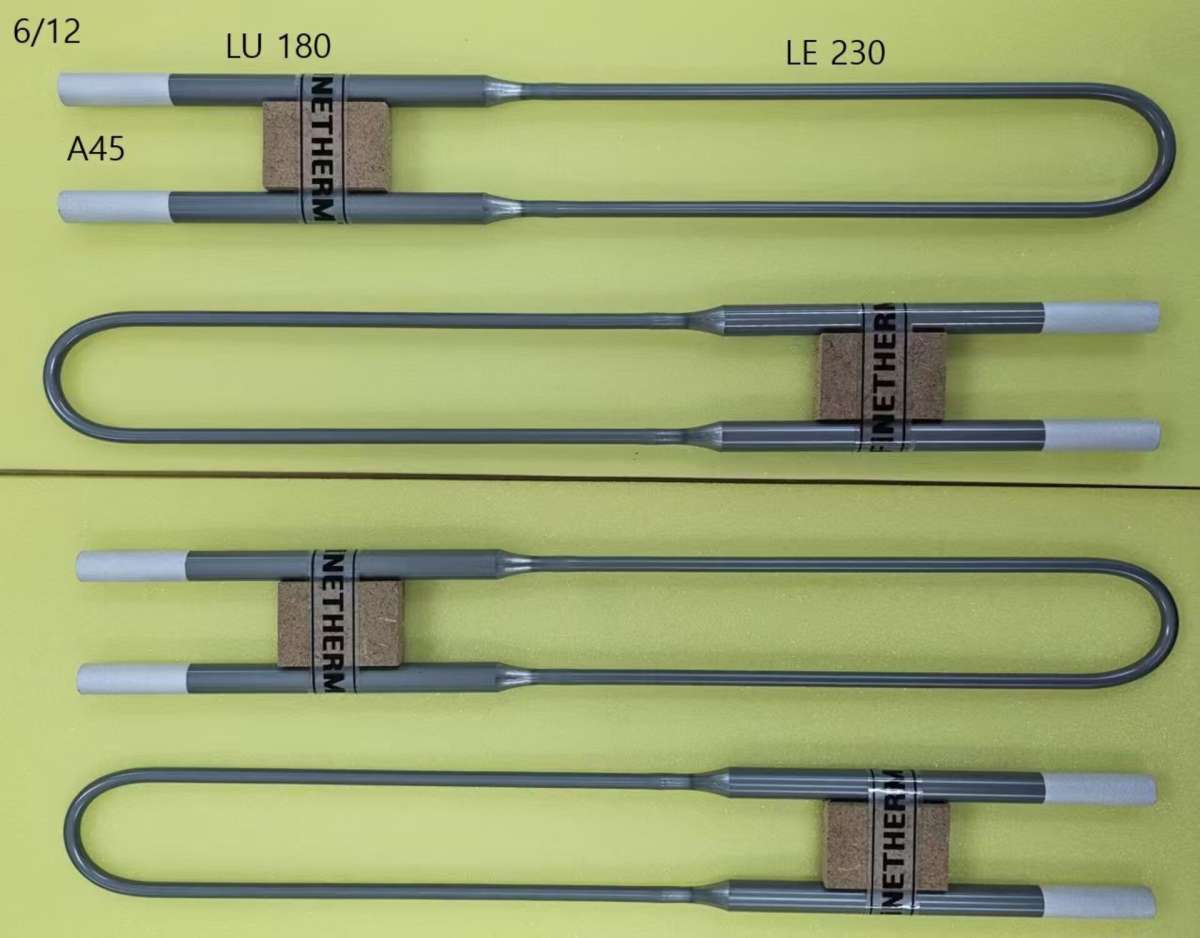
The choice between these zirconia sintering element alternatives is rarely settled by maximum temperature alone. Chamber uniformity, heating rate, atmosphere, controller capacity, and replacement practices all affect the result. An element that reaches the target temperature on a specification sheet may still be a poor fit if it must operate too close to its limit or cannot be supported by the existing power system.
MoSi2 and SiC at a glance
Neither material guarantees a better sintered part. Both can be used in well-designed furnaces, but their practical boundaries differ. The comparison starts with the zirconia manufacturer’s specified firing cycle and the furnace’s ability to deliver it across the load.
Start with the cycle, then establish the element temperature
The setpoint on the controller is not the same as the surface temperature of the heating element. Heat must pass from the element through the furnace chamber to the zirconia load. During heating, the element can be substantially hotter than the measured chamber temperature, particularly when the load is heavy, the requested ramp is fast, or heat transfer is restricted.
That difference matters when comparing an element rating with a zirconia recipe. A material may appear suitable because its stated maximum exceeds the chamber setpoint, yet have too little operating margin once the required heat flow is considered. A long hold near the upper limit can also place different demands on an element than a brief excursion to the same chamber temperature.
MoSi2 is often selected for high-temperature zirconia work because appropriate grades offer greater temperature capability. That headroom can help a furnace reach and maintain a demanding cycle without requiring the element to run as close to its specified limit. It does not remove the need to check the actual element grade, the furnace atmosphere, the mounting arrangement, and the conditions under which the supplier’s rating applies.
SiC remains a credible option when the firing temperature, ramp rate, and load allow sufficient element margin. It can be attractive in a furnace already engineered around SiC, especially if the existing electrical system supports its resistance change over time. The relevant question is whether the complete furnace can deliver the required cycle throughout the element’s useful life.
Fast cycles change the calculation
A rapid zirconia cycle demands more than a high maximum setpoint. The furnace must deliver enough power during the ramp, control temperature without unacceptable overshoot, and maintain an acceptable temperature distribution across the load. Elements, insulation, thermocouple placement, chamber geometry, and controller tuning all contribute.
A higher-rated MoSi2 grade may provide useful margin for a fast cycle, but changing element material alone will not turn a conventional furnace into a reliable fast-sintering system. Likewise, a SiC-equipped furnace should be assessed against the full cycle rather than rejected solely because the recipe uses a short hold.
Temperature uniformity and zirconia quality
Zirconia properties depend on receiving the intended thermal treatment. If parts experience different temperatures or spend different lengths of time within the critical portion of the cycle, differences in densification and final dimensions can follow. For dental restorations and precision ceramic parts, inconsistent shrinkage can translate into fit problems or additional work.
Element material affects the design options available to the furnace builder, but it is only one contributor to uniformity. Element placement, spacing, chamber insulation, load position, setters, thermocouples, and control logic also matter. A thermocouple reading at one location does not establish that every part in a packed chamber follows the same temperature profile.
When comparing furnace designs or a proposed element change, ask how temperature distribution is assessed under a representative load. An empty-chamber result can be useful for checking the furnace, but it does not fully describe how a dense load of zirconia components heats. The acceptance criterion should relate to the parts and cycle being run, including any limits set by the zirconia manufacturer.
Contamination deserves a separate review. Element condition, insulation dust, furnace furniture, and the chamber environment can all affect product cleanliness. If color or translucency is important, validate the complete firing setup with the intended materials and loading arrangement; the element designation alone is not a cleanliness specification.
Electrical behavior changes operating and replacement decisions
MoSi2 and SiC require different attention from the power system. For MoSi2, electrical resistance varies considerably between a cold element and an operating element. The transformer or other power supply, switching devices, and control strategy must be selected for the actual element design and its operating range. Connection quality matters as well: poor contacts can create localized heating at terminals even when chamber temperature appears normal.
SiC elements gradually change resistance as they age. As resistance rises, a power system with a limited voltage range may eventually be unable to deliver the power needed for the specified cycle. The operator may first see slower heating, difficulty reaching the hold temperature, or longer recovery after loading. Element aging is one possible cause, although insulation damage, connection faults, and other electrical problems can produce similar symptoms.
This behavior affects replacement planning. In a multi-element SiC furnace, mixing elements with substantially different resistances can lead to uneven power distribution, depending on the circuit arrangement. Before replacing one failed element, check the furnace builder’s instructions for measuring and matching the remaining elements and for deciding whether to replace an individual element or a group.
For MoSi2, follow the element and furnace suppliers’ guidance on compatible grades, dimensions, and electrical connections. A replacement must fit the designed circuit and mounting arrangement. Resistance readings should be interpreted using the appropriate procedure for the material and temperature, rather than applying the same acceptance rule to both element types.
Purchase price does not settle the cost comparison
The installed element price is only one part of the cost of heat. A useful comparison includes the power supply and controls, expected replacement pattern, maintenance labor, downtime, and the cost of rejected or delayed parts. For an existing furnace, conversion hardware and production interruption may outweigh a difference in element purchase price.
Service life should be treated as a function of operating conditions, not a fixed number attached to a material. Temperature, hold time, cycling, atmosphere, element loading, mechanical handling, and furnace design can all change the outcome. When requesting an estimate, provide the actual cycle and load rather than asking for a generic lifespan.
Atmosphere, handling, and failure conditions
Both materials rely on surface behavior that is affected by temperature and atmosphere. MoSi2 and SiC can form silica-based protective layers under suitable oxidizing conditions, but those layers are not protection against every furnace environment. Vapors from binders, coatings, insulation, or processed materials may interact with the element or its surface; reducing conditions and certain contaminants can also change expected performance.
For a zirconia furnace running in air, the supplier still needs to know what else enters the chamber during the cycle. A clean sintering load and a load carrying substantial organic residue do not present identical conditions. If debinding is part of the process, specify where it takes place and what atmosphere or exhaust conditions the elements will see.
Mechanical design matters during installation and service. Both SiC and MoSi2 elements are brittle and can be damaged by impact, misalignment, or excessive force at the terminals. Supports must allow for thermal movement as directed by the furnace and element manufacturers. An element that fits through the insulation opening can still be poorly supported or incorrectly connected.
When an element fails, inspect the broader failure location and operating history before ordering an identical replacement. A break near a support may point to a different problem than damage concentrated at an electrical connection. Repeated failures in the same position justify checking alignment, local temperature, connections, loading, and chamber conditions rather than assuming that the material itself is unsuitable.
Can an existing furnace switch from one material to the other?
Sometimes, but it is a furnace redesign question rather than a straightforward consumable substitution. MoSi2 and SiC elements can differ in geometry, resistance, terminal arrangement, mounting requirements, and operating characteristics. Even when a replacement can be made to fit physically, the existing transformer, wiring, switching components, and controller may not deliver the correct power across the operating range.
Before approving a conversion, the furnace builder or a qualified engineer should review:
- The zirconia cycle, including peak chamber temperature, ramp rates, hold time, cooling requirements, and representative load.
- The proposed element grade and its allowable operating conditions, including the expected element temperature and furnace atmosphere.
- Available voltage, current, power-control range, circuit arrangement, and protection devices.
- Element dimensions, hot and cold zones, supports, terminal clearances, insulation penetrations, and provision for thermal movement.
- The effect on chamber temperature distribution, product cleanliness, maintenance access, and replacement procedures.
Any conversion should be followed by verification of the cycle with a representative load and acceptance checks appropriate to the zirconia product. The objective is to establish that the modified furnace can repeatedly produce the required thermal profile, not merely that it reaches the setpoint once.
For a new high-temperature zirconia furnace, begin by assessing MoSi2 when temperature headroom is a leading constraint. For an established SiC furnace operating within a comfortable margin, first examine whether its aging allowance and maintenance practices meet production needs. In either case, select the element grade and electrical system around the complete firing cycle and the parts the furnace must consistently produce.